
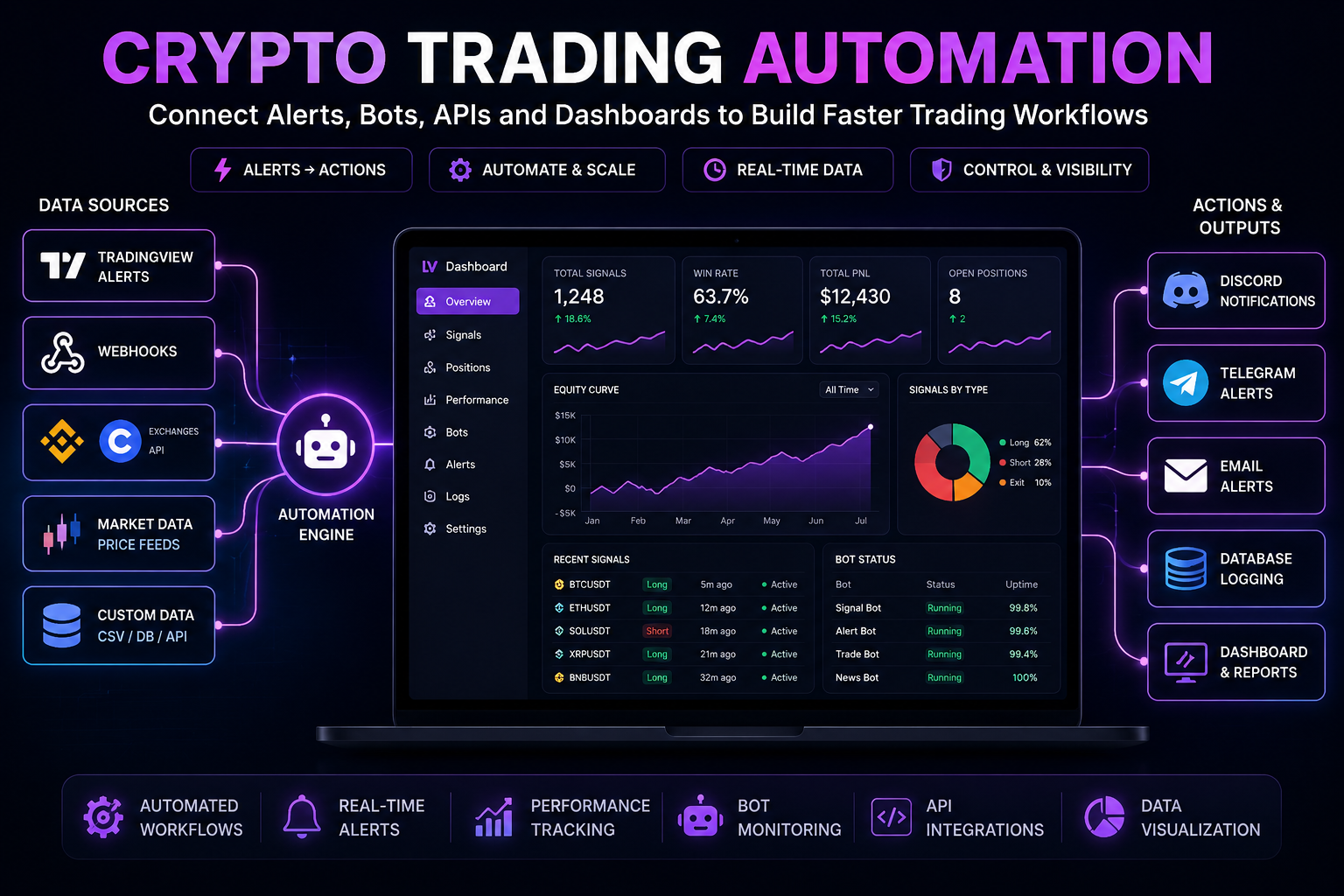
Crypto Trading Automation connects TradingView alerts, bots, APIs and dashboards for faster crypto workflows. Instead of manually checking charts, copying signals and updating multiple platforms, traders can use automation to route alerts, monitor bots, store data and send real-time notifications.
In 30 Seconds
- Crypto Trading Automation connects alerts, bots, APIs and dashboards.
- Automated workflows can route TradingView alerts to Discord, Telegram and databases.
- Dashboards can track signals, bot status, performance data and workflow activity.
- As a result, traders can manage crypto workflows with better speed and visibility.
What Is Crypto Trading Automation?
Crypto Trading Automation is the process of connecting crypto trading tools into structured workflows. These systems can receive TradingView alerts, process webhook data, send Discord or Telegram notifications, update dashboards, store logs and connect with exchange APIs.
In practice, automation does not always mean fully automated trade execution. Many useful systems start with alerts, signal routing, reporting, bot monitoring and dashboard visibility.
Therefore, crypto automation should improve the trading process, reduce repetitive work and make data easier to monitor.
Why Crypto Traders Use Automation
Crypto markets operate continuously, which makes manual monitoring difficult. Traders may need to watch several markets, timeframes, alerts, exchanges, bots and communication channels at the same time.
Automation helps reduce that operational load. For example, a TradingView alert can trigger a webhook, send a formatted signal to Discord, notify a Telegram group and store the event inside a dashboard.
As a result, traders and communities can react faster while keeping their workflow more organized.
Real-Time Alerts
Send crypto market alerts to Discord, Telegram, email or custom dashboards.
Bot Monitoring
Track bot status, webhook activity, failed alerts, logs and workflow events.
API Workflows
Connect exchanges, databases, TradingView, dashboards and notification systems.
Data Visibility
Centralize signals, alerts, metrics and performance data in one interface.
What Can Crypto Trading Automation Do?
Crypto automation can support many parts of the trading workflow. However, the best systems usually start with one clear problem: alert delivery, signal tracking, bot monitoring, API integration or dashboard reporting.
- TradingView alert routing through webhooks and backend APIs.
- Discord notifications for private trading communities and signal channels.
- Telegram alerts for mobile trading updates and group notifications.
- Exchange API integrations for account data, market data or workflow actions.
- Signal databases for storing alerts, setups, timestamps and results.
- Trading dashboards for monitoring signals, bots, logs and performance data.
- Risk notifications for invalidation levels, volatility or market events.
- Webhook systems for connecting TradingView with external tools.
- Bot status monitoring for uptime, errors, delivery and system health.
- Custom reports for traders, analysts and trading communities.
Example Crypto Automation Workflow
- First, TradingView detects a crypto market condition.
- Then, the alert sends data through a webhook.
- Next, an automation engine receives and validates the alert payload.
- After that, the system formats the signal message.
- Meanwhile, Discord or Telegram notifications are sent automatically.
- The dashboard stores the signal, bot status and workflow log.
- Finally, the trader reviews alerts, metrics and system activity in one place.
Manual Crypto Workflows vs Automated Systems
Manual workflows can work when the trading process is small. However, they become harder to manage when alerts, bots, APIs, dashboards and communities are involved.
By contrast, an automated system can receive data, apply rules, route messages and store logs without constant manual action. As a result, the workflow becomes faster, cleaner and easier to scale.
Manual Workflows vs Crypto Automation
Manual Workflow
- Requires constant monitoring
- Signals are copied manually
- Harder to track alerts
- No structured bot logs
- Limited dashboard visibility
Automated Workflow
- Routes alerts instantly
- Sends structured notifications
- Stores signals and logs
- Connects APIs and bots
- Displays data in dashboards
TradingView Alerts and Crypto Automation
TradingView is often the starting point for crypto automation. A trader can create alert conditions based on price levels, indicators, Pine Script logic, market structure, volatility or custom setups.
Once an alert triggers, TradingView can send data through a webhook. Then, a custom backend can process the payload, format the message and route it to the correct platform.
This creates a practical connection between chart-based analysis and automated workflow delivery.
Exchange APIs and Crypto Workflow Integrations
Exchange APIs can add more context to an automated workflow. Depending on the project, APIs may provide market data, account information, position status, execution events or reporting data.
For example, a system can combine TradingView alerts with exchange data, database logs and dashboard metrics. In addition, APIs can support reporting workflows, risk monitoring and operational checks.
However, any automation connected to execution requires careful design. Validation, permissions, logging, limits and manual oversight are important parts of a safer system architecture.
Crypto Automation for Discord and Telegram
Crypto communities often use Discord and Telegram for market updates, signals and member communication. In that context, automation helps deliver information quickly and consistently.
Instead of copying alerts manually, the system can send structured messages to selected channels or groups. For example, a signal can include symbol, direction, timeframe, price level, status and additional notes.
As a result, trading communities can reduce manual posting while keeping alerts organized.
When Should You Use Crypto Trading Automation?
Crypto automation makes sense when the workflow is repetitive, time-sensitive or spread across several platforms. It is especially useful when alerts, bots, dashboards and communities need to work together.
However, automation should not be built before the trading workflow is clear. First, define the process. Then, automate the parts that are structured, repetitive and valuable.
- TradingView alerts need to reach Discord or Telegram quickly.
- Signals should be stored in a structured database.
- Bot activity requires monitoring and logs.
- Crypto dashboards need real-time data.
- Manual signal posting takes too much time.
- API data should connect with internal workflows.
- Trading communities need consistent notifications.
- Risk alerts or market events need better visibility.
- Multiple tools should work together automatically.
- The trading process is clear enough to define in rules.
Common Crypto Trading Automation Projects
Most crypto automation projects start from an operational problem. The goal is not to automate everything immediately, but to create a system that improves speed, visibility and workflow control.
Alert Routing System
Send TradingView alerts to Discord, Telegram, dashboards, email or databases.
Signal Bot
Format and publish crypto alerts for private communities or internal teams.
Trading Dashboard
Track signals, bot status, workflow logs, market data and performance metrics.
API Integration Layer
Connect exchanges, databases, analytics tools and notification systems.
Automation, Execution and Risk Control
Some crypto systems support execution workflows, but full execution automation needs stricter controls than alert automation. Any system that places orders or manages positions should include validation, permissions, rate limits, risk rules, error handling and logs.
For many traders, the safer first step is alert and workflow automation. This allows the trader to centralize data, test the process and keep manual control before moving toward more advanced execution systems.
Therefore, crypto trading automation should improve process control rather than remove responsibility from the trader.
How Luminova Ventures Builds Crypto Automation Systems
Luminova Ventures builds crypto automation systems around real trading workflows. The focus is practical infrastructure: TradingView alerts, webhook routing, APIs, Discord notifications, Telegram alerts, dashboards, databases, bot monitoring and reporting.
Typical projects include crypto signal bots, TradingView alert workflows, Pine Script alert logic, trading dashboards, Discord signal systems, Telegram alert bots, webhook APIs and custom reporting tools.
- Trading Bot Development
- Trading Dashboard Development
- TradingView Alert Workflows
- Pine Script Automation
- Discord Bot Automation
- Telegram Alert Systems
- Business API Integration
- Free Automation Audit
Frequently Asked Questions About Crypto Trading Automation
What is Crypto Trading Automation?
Crypto Trading Automation means connecting alerts, bots, APIs, dashboards and notification systems to support crypto trading workflows with less manual work.
Can crypto automation connect TradingView with Discord?
Yes. Through webhooks, TradingView alerts can move into a backend system that formats and sends crypto signals to Discord channels automatically.
Can Telegram receive automated crypto alerts?
Yes. Telegram bots can send alerts to private chats, groups or channels based on TradingView alerts, API data or custom market conditions.
Does crypto automation always mean automated trading execution?
No. Many systems focus on alerts, dashboards, notifications, reporting and workflow automation. Automated execution is a separate and more advanced use case.
Who should use crypto trading automation?
Crypto traders, analysts, educators and trading communities can use automation to manage alerts, signals, bots, dashboards and workflow data more efficiently.
Build Crypto Automation for Your Trading Workflow
Request a free Automation Audit and discover how custom crypto automation can connect alerts, bots, APIs, dashboards, Discord and Telegram into one clear workflow.
Request Free Automation AuditLooking for more practical AI, automation and software development resources?
← Back to Knowledge Base