
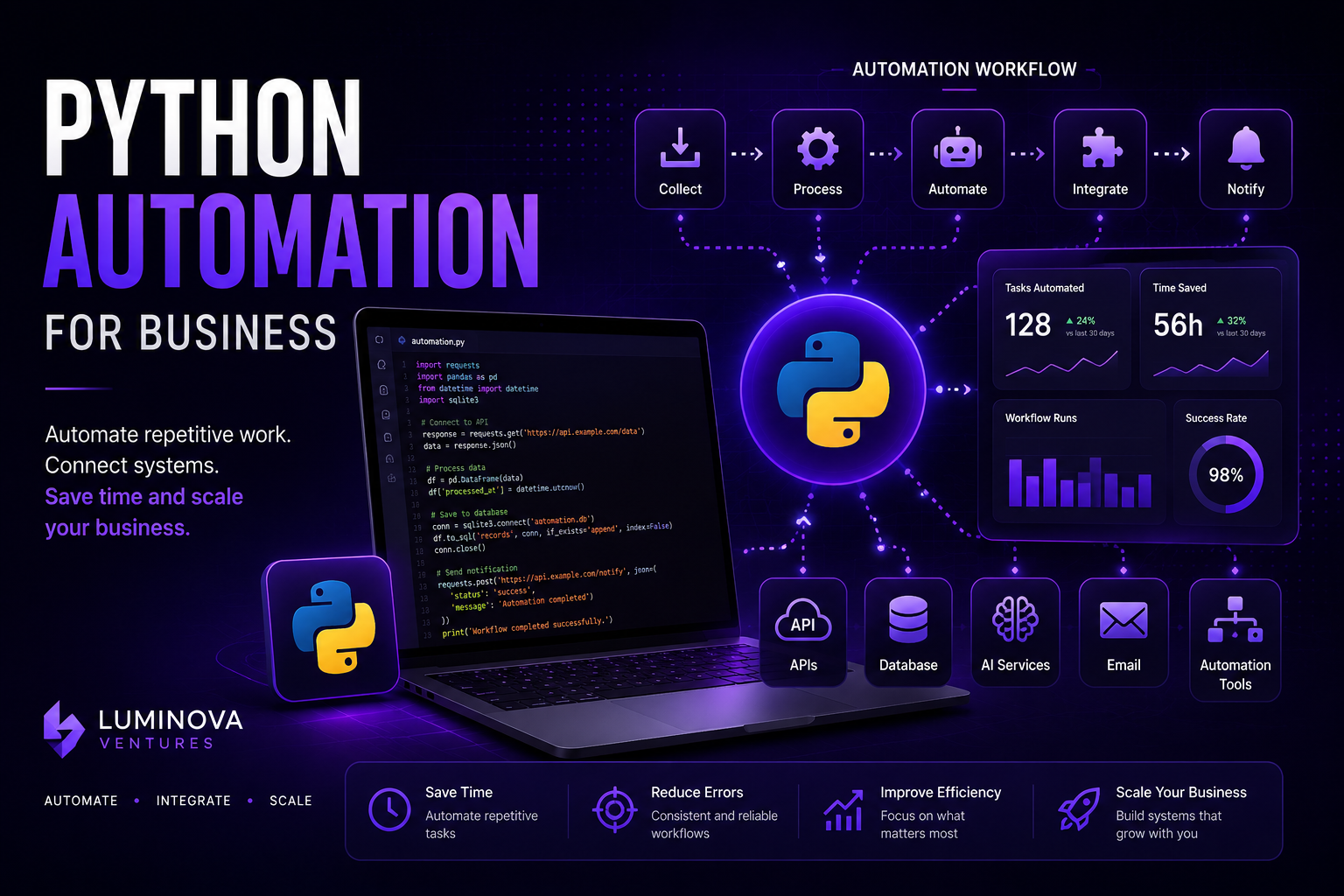
Python Automation helps businesses eliminate repetitive work by connecting software, processing data automatically and integrating business systems through custom workflows. Instead of relying on manual tasks, companies can use Python to automate operations, improve accuracy and scale their processes more efficiently.
In 30 Seconds
- Python automates repetitive business tasks.
- It connects APIs, databases and cloud services.
- Automation reduces manual work and operational errors.
- Python scales from simple scripts to enterprise automation platforms.
What Is Python Automation?
Python automation is the process of using Python programs to execute repetitive business tasks without human intervention. Instead of employees manually copying data, generating reports, updating spreadsheets or transferring information between systems, Python performs these operations automatically according to predefined rules.
Because Python is flexible, reliable and supported by thousands of libraries, it has become one of the most popular programming languages for workflow automation, API integration, artificial intelligence and business software development.
Whether a company wants to automate internal reporting, synchronize customer information or build AI-powered workflows, Python provides a scalable foundation that can grow together with the business.
Why Businesses Choose Python for Automation
Many automation platforms work well for simple scenarios, but businesses often reach a point where they need greater flexibility, better integrations and complete control over their workflows. Python makes this possible without being tied to a specific vendor or platform.
Organizations can automate almost every digital process, from document generation and API communication to AI processing, notifications, monitoring and infrastructure management.
Unlimited Flexibility
Create workflows tailored to your business instead of adapting your processes to software limitations.
Powerful Integrations
Connect CRMs, ERPs, payment systems, dashboards, AI models and cloud platforms through APIs.
Reliable Automation
Run scheduled tasks automatically with consistent logic and significantly fewer manual errors.
Future Scalability
Start with a small automation script and expand it into a complete business platform over time.
Common Python Automation Use Cases
Python can automate thousands of repetitive business activities. The highest return usually comes from processes employees perform every day.
- Report generation from multiple databases.
- API integrations between different software platforms.
- Email automation with personalized notifications.
- CRM synchronization between websites and sales systems.
- Invoice and document processing.
- AI-powered text analysis and summarization.
- Dashboard updates in real time.
- Data validation before entering internal systems.
- Scheduled backups and monitoring tasks.
- Internal workflow automation for teams.
Example Python Automation Workflow
- A customer submits a contact form.
- Python validates the submitted data.
- The information is stored in a PostgreSQL database.
- An API updates the CRM automatically.
- An AI model summarizes the request.
- A notification is sent to the sales team.
- The dashboard refreshes automatically.
Python Automation vs Manual Work
Manual work often seems manageable until business activity increases. As more customers, projects and data appear, repetitive tasks consume valuable employee time and increase the likelihood of mistakes.
Python automation replaces repetitive work with repeatable business logic. Once a workflow has been designed and tested, it performs the same process consistently regardless of volume.
Manual Process vs Python Automation
Manual Process
- Repeated employee actions
- Higher probability of human error
- Slow processing
- Difficult to scale
- Time-consuming reporting
Python Automation
- Automatic execution
- Consistent business rules
- Faster operations
- Scales with company growth
- Real-time processing
Python Libraries Commonly Used in Business Automation
One of Python’s biggest strengths is its ecosystem. Thousands of libraries make it possible to automate almost any business process without building everything from scratch.
When Should a Business Invest in Python Automation?
Python automation becomes valuable when employees repeatedly perform the same digital tasks every day. If a process follows clear rules and requires little human judgment, it can often be automated.
Companies usually achieve the greatest return by automating repetitive operational work before expanding into more advanced AI-powered systems.
- Employees copy information between systems.
- Reports are generated manually every week.
- Business software does not communicate automatically.
- Customer information exists in multiple locations.
- Teams spend hours updating spreadsheets.
- Management needs real-time operational data.
Python Automation and API Integration
Python is especially effective when automation requires communication between different systems. Many modern platforms provide APIs, which allow software to send, receive and update information automatically.
For example, a Python automation workflow can collect data from a website form, send it to a CRM, trigger an email response, update a database and notify a team through Discord or Slack. This type of API integration removes manual steps and makes business systems work together.
Python can also integrate AI models through services such as OpenAI, making it possible to add classification, summarization, document analysis and intelligent response generation to internal workflows.
Python Automation for Data Processing
Data processing is one of the strongest use cases for Python automation. Many companies collect data from multiple sources, but the information is often scattered across spreadsheets, forms, databases and third-party tools.
Python can clean, transform, validate and prepare this data automatically. This improves reporting quality and reduces the risk of decisions being made on outdated or incomplete information.
- Clean duplicated or incomplete records.
- Transform raw data into structured reports.
- Validate customer information before saving it.
- Combine data from multiple platforms.
- Prepare datasets for dashboards or AI systems.
How Luminova Ventures Builds Python Automation Systems
Luminova Ventures builds Python automation systems around real operational workflows. The goal is not to create unnecessary software, but to identify repetitive work, connect existing tools and build automation that saves time every week.
Typical projects include API integrations, automated reporting, AI assistants, dashboard pipelines, notification systems and internal business workflows.
- Python Infrastructure Automation
- API Integration Workflow
- AI Business Assistant
- AI Analytics Dashboard
- Free Automation Audit
Frequently Asked Questions About Python Automation
What is Python automation?
Python automation means using Python scripts or applications to perform repetitive digital tasks automatically, such as data processing, API communication, reporting, notifications and workflow execution.
Why is Python used for business automation?
Python is widely used because it is flexible, reliable and supported by a strong ecosystem of libraries for APIs, databases, data processing, AI integration and backend automation.
Can Python connect different business systems?
Yes. Python can connect CRMs, databases, dashboards, websites, payment systems, email platforms, AI models and internal tools through APIs and webhooks.
Is Python automation only for large companies?
No. Small and mid-sized companies can use Python automation to reduce manual work, improve reporting, connect tools and automate internal processes without building large software platforms.
Need Help Automating Repetitive Work?
Request a free Automation Audit and discover where Python automation can save time, reduce errors and connect your business systems.
Request Free Automation AuditLooking for more practical AI, automation and software development resources?
← Back to Knowledge Base