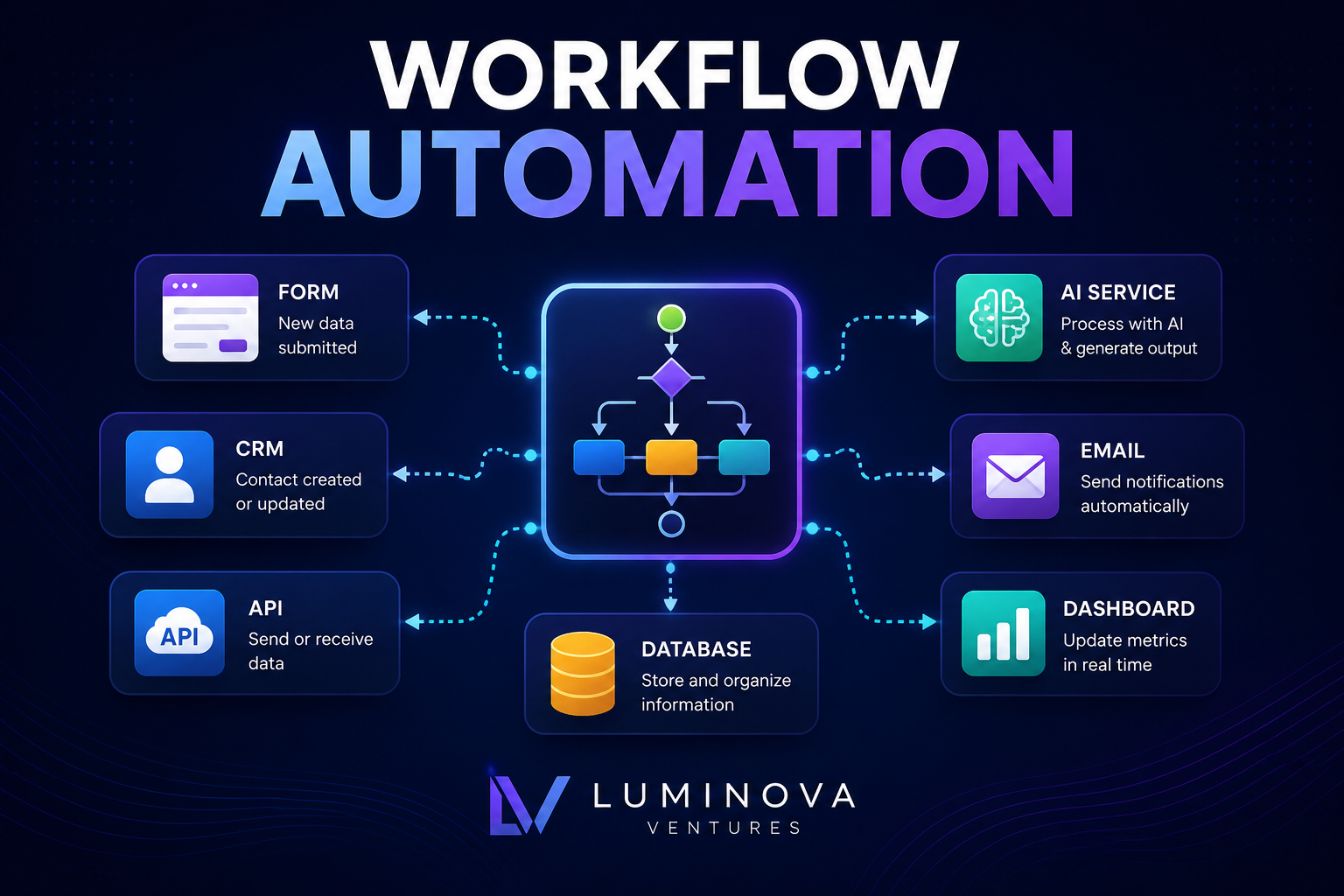
Workflow Automation helps businesses eliminate repetitive tasks by connecting software, data and employees into one automated process. Instead of manually moving information between systems, workflow automation ensures every step happens automatically, consistently and with fewer errors.
In 30 Seconds
- Automated workflows removes repetitive manual work.
- Business systems exchange information automatically.
- Automation improves speed, consistency and accuracy.
- Well-designed workflows scale together with the business.
What Is Workflow Automation?
Workflow solution is the process of replacing repetitive manual tasks with automated sequences that move information between business systems. Instead of relying on employees to perform the same actions every day, software executes those steps automatically based on predefined rules.
A workflow can begin with a customer submitting a form, continue by updating a CRM, trigger an email notification, send data to an AI service and finally generate a report for management. Every step happens automatically, reducing delays and improving operational consistency.
Modern workflow automation is no longer limited to large enterprises. Small and medium-sized businesses can automate sales, marketing, customer support, reporting and internal operations using APIs, custom software and artificial intelligence.
Why Workflow Automation Is Important
Many businesses already use several software platforms, but those tools often operate independently. Employees spend hours copying information between applications, updating spreadsheets and manually notifying colleagues when something changes.
Automated process removes these repetitive activities by allowing systems to communicate automatically. Employees can focus on decisions and customer service instead of administrative work.
Save Time
Automate repetitive work that employees perform every day.
Reduce Errors
Eliminate mistakes caused by manual data entry and duplicated work.
Increase Speed
Business processes continue automatically without waiting for manual actions.
Improve Scalability
Automated workflows continue working as your business grows.
Examples of Workflow System
Workflow automation can improve almost every department inside a business. The biggest benefits usually come from automating processes that happen hundreds of times every month.
- Lead management from website forms.
- CRM synchronization across multiple systems.
- Email notifications for employees and customers.
- Invoice approval workflows.
- Customer onboarding automation.
- AI document processing.
- Reporting dashboards.
- Project status updates.
- Internal approval systems.
- Support ticket routing.
Typical Workflow Automation Process
- A customer submits a form.
- The workflow validates the information.
- The CRM receives the new contact.
- An API updates the internal database.
- An AI model classifies the request.
- Email notifications are sent automatically.
- A dashboard updates management metrics.
Workflow System vs Manual Processes
Manual workflows become increasingly difficult to manage as a business grows. Employees spend more time transferring information between systems than performing valuable work.
Workflow solution standardizes every step, making processes faster, more predictable and easier to monitor.
Manual Workflow vs Workflow Automation
Manual Workflow
- Repeated manual tasks
- Human errors
- Delayed communication
- Difficult reporting
- Poor scalability
Workflow Automation
- Automatic execution
- Consistent business logic
- Real-time communication
- Instant reporting
- Scalable operations
Technology Behind Workflow Automation
Modern workflow automation combines several technologies to create reliable business systems. APIs allow software to exchange data, databases store information, while automation engines coordinate every step of the workflow.
When Should a Business Automate a Workflow?
Workflow solution delivers the greatest value when employees perform the same digital process repeatedly. If information is copied between systems, reports are prepared manually or approvals require multiple emails, automation can significantly reduce operational effort.
The best workflows to automate are those that are repetitive, rule-based and consume valuable employee time without requiring complex human judgment.
- Manual data entry between multiple systems.
- Customer onboarding processes.
- Sales and CRM updates.
- Weekly or monthly reporting.
- Internal approval workflows.
- Invoice processing.
- Employee notifications.
- Customer support routing.
Workflow Solution and AI
Artificial intelligence extends workflow system beyond simple rule-based processes. AI can classify requests, summarize documents, analyze customer messages and generate responses before the workflow continues automatically.
Instead of replacing automation, AI becomes another step inside the workflow. Business systems collect information, APIs transfer data, AI processes the content and the workflow delivers the result to employees or customers.
Modern AI services such as OpenAI make it possible to integrate language models directly into workflow automation without changing the entire business infrastructure.
How Luminova Ventures Builds Workflow Systems
Luminova Ventures designs workflow automation around business processes rather than software features. Every workflow is mapped, simplified and connected through APIs, custom software and AI where it creates measurable value.
Instead of introducing another platform, the goal is to make existing business systems communicate automatically while reducing manual work and operational bottlenecks.
- AI Business Assistant
- Python Infrastructure Automation
- API Integration Workflow
- AI Analytics Dashboard
- Free Automation Audit
Frequently Asked Questions About Business Workflow
What is workflow automation?
Workflow automation is the process of replacing repetitive manual business tasks with automated workflows that move information between systems without human intervention.
What can workflow system automate?
Workflow automation can automate customer onboarding, CRM updates, reporting, notifications, approvals, document processing, API integrations and many internal business operations.
What is the difference between workflow automation and business automation?
Workflow automation focuses on automating a specific sequence of tasks, while business automation usually combines multiple automated workflows into a complete operational system.
Can workflow process include AI?
Yes. AI can classify information, summarize documents, generate responses and support decision-making inside automated workflows, making business processes more intelligent and efficient.
Ready to Automate Your Business Workflows?
Request a free Automation Audit and discover which workflows can be automated to save time, reduce manual work and improve operational efficiency.
Request Free Automation AuditLooking for more practical AI, automation and software development resources?
← Back to Knowledge Base